Hosting guide
Why Hosting Infrastructure Affects Funding Decisions
In short
Investors look at your hosting during due diligence: what it costs, who it depends on, whether data stays in the UK and what happens when it fails. Cheap hosting that leads to an outage, a breach or a forced migration costs runway, and runway affects how much equity you give up in the next round.

Why hosting infrastructure affects funding and startup runway
Infrastructure crises (slow pages under load, security breaches, forced migrations) eat into margins and runway. Less runway can push a founder to raise sooner and on worse terms, giving away more equity than planned.
Cheap hosting's extra costs don't show on the price page. Egress fees, data-migration bills and compliance penalties turn up months later, often when the next round is close and switching providers is hardest.
A security incident moves engineering time from product to incident response, costs customer trust and can bring regulators to the door. Each has a direct cost, and together they lower the valuation a founder can defend.
- Egress and migration fees add up quietly and hit hardest during growth.
- Security incidents divert engineering resource and raise customer-acquisition costs through reputational damage.
- Compliance fines reduce runway and signal governance risk to investors.
- Performance failures during traffic spikes damage conversion rates and revenue projections.
- Forced platform migrations consume months of engineering time and delay product roadmaps.
What hosting infrastructure investment looks like at scale
Infrastructure is attracting big money at the top end. KKR launched Helix with over $10 billion focused on next-generation AI infrastructure, and CPP Investments committed over $1 billion for AI-ready data-centre campuses. For a startup, the useful question is which cost model fits your stage.
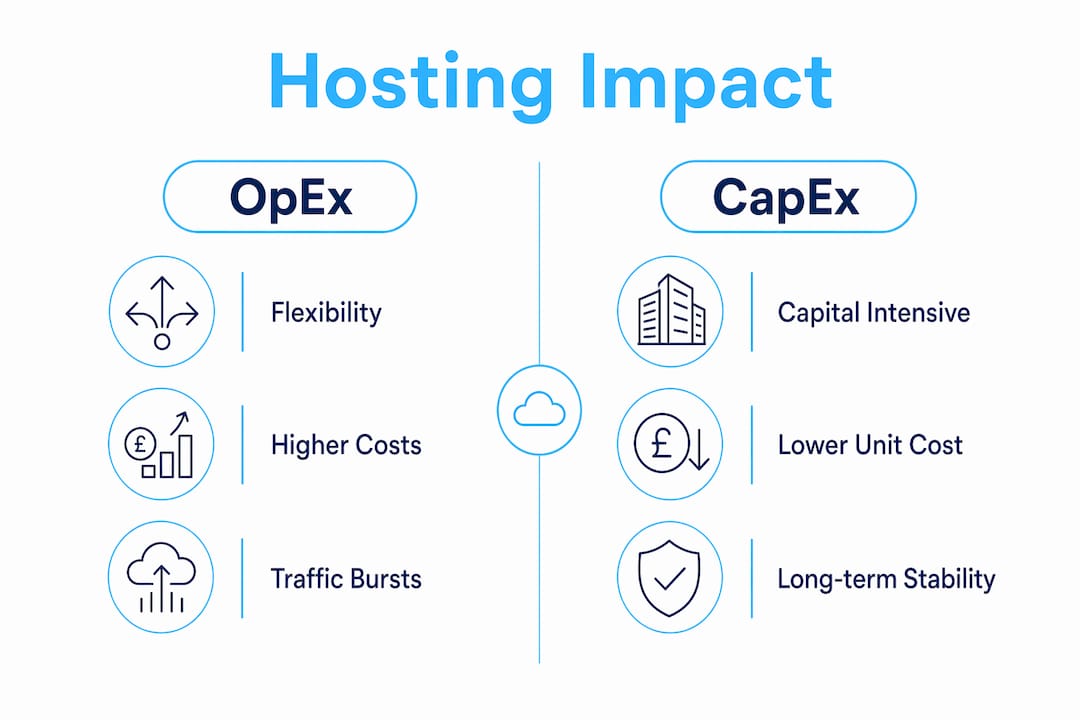
Whether you pay as you go (OpEx) or commit to owned or reserved capacity (CapEx) changes how your cost structure reads to an investor.
| Cost model | Financial profile | Best suited to |
|---|---|---|
| OpEx (pay-as-you-go) | Higher unit cost, flexible spend | Early-stage startups with variable traffic |
| CapEx (owned or reserved) | Lower unit cost, predictable economics | Growth-stage businesses with stable workloads |
| Hybrid | Balanced cost and flexibility | Scaling businesses managing mixed demand |
OpEx hosting favours agility for traffic bursts but carries a higher price per unit. CapEx, such as data-centre colocation or reserved VPS capacity, needs more money up front but gives predictable unit costs, which makes the financial model easier to defend. Choosing the wrong model for your growth stage shows up directly in your burn rate, one of the first numbers an investor examines.
How infrastructure risks affect investor due diligence

Technical due diligence looks for risks that could cost money after the deal closes. Poor hosting creates unplanned spending, often at the worst moment. These findings lower valuations or stall rounds:
- Single points of failure signal operational immaturity to technical investors.
- Absence of disaster recovery raises questions about business continuity.
- Non-compliant data handling creates legal liability investors price in, or walk away over.
- Vendor lock-in increases switching costs and weakens long-term cost projections.
- Poor uptime history undermines revenue reliability, a core valuation input.
A public breach or a long outage also follows a startup into every funding conversation. Equity given up in a rushed round doesn't come back.
Strategies for aligning hosting choices with funding goals
Five steps that make your hosting easier to defend in due diligence:
- Map your cost model to your growth stage. Early-stage businesses with unpredictable traffic benefit from OpEx flexibility; growth-stage businesses with stable workloads should consider reserved capacity or colocation to cut unit costs and improve predictability.
- Prioritise compliance from day one. GDPR compliance and data sovereignty are baseline requirements investors check. Hosting your data within the UK on a provider that documents its compliance posture removes a common due-diligence question.
- Audit the total cost of ownership. Include bandwidth, egress fees, support and the engineering time to manage it. A cheaper plan that demands ten hours of engineering a month isn't cheaper at all.
- Choose infrastructure that supports your roadmap. If your plans include AI features, data-intensive workloads or rapid expansion, your hosting needs to scale without a disruptive migration at the worst time.
- Document your infrastructure for investors. Write down your strategy, cost model, compliance position and disaster-recovery plan before anyone asks for them.
What getting it wrong looks like
We've spoken with founders who lost months of runway to a hosting migration they didn't plan for. Each time, the cheapest option had looked sensible: a low price, quick setup, the immediate problem solved. The cost came later, when traffic grew, compliance tightened, or a security incident forced an emergency response.
The warning signs were there beforehand: no clear egress pricing, no documented compliance, no disaster-recovery plan, no UK-based support. Founders miss them because they're focused on product. Investors look at the whole business.
Paying a little more each month for hosting you can explain to an investor costs less than an unplanned migration in the middle of a round.
UK hosting you can explain to an investor
Flat monthly prices with no hidden egress fees, data held in the UK and a UK support team, across web hosting, VPS, colocation and managed services. Migration is free.
See hosting plansQuestions
Does hosting infrastructure affect startup valuation?
Yes. Infrastructure-related crises such as security breaches, forced migrations and compliance failures erode margins and force dilutive financing, which directly reduces startup valuation during funding rounds.
What hosting cost model is best for early-stage startups?
OpEx hosting offers the flexibility that early-stage startups need for variable traffic, though the unit cost is higher than reserved or CapEx-based capacity. Match your model to your current growth stage and traffic predictability.
How does GDPR compliance relate to hosting and funding?
Non-compliant data handling creates legal liability that investors price into their offer or use to exit a funding process. Hosting in the UK or EU with a GDPR-compliant provider takes this question off the table.
What is infrastructure debt and why does it matter for funding?
Infrastructure debt is the accumulated technical and financial risk created by poor hosting decisions. Like financial debt it must eventually be paid, often through unplanned capital spend or equity dilution at the worst possible time.
How do investors evaluate hosting infrastructure during due diligence?
Investors examine uptime history, compliance posture, disaster recovery plans, vendor lock-in risk and total cost of ownership. A clear, written infrastructure plan answers most of those questions up front.