WordPress LiteSpeed Configuration Guide for Faster Sites
WordPress configuration is one of the most effective ways to improve site speed and reduce server load. If you’re hosting WordPress on LiteSpeed and not configuring LiteSpeed Cache properly, you’re missing out on most of the performance benefits.
LiteSpeed Cache isn’t just another WordPress plugin. It integrates directly with the LiteSpeed Web Server, allowing pages to be cached before WordPress and PHP even load. That’s why WordPress LiteSpeed setups consistently outperform generic caching plugins like WP Super Cache or W3 Total Cache.
This guide explains how WordPress LiteSpeed works and how to configure it correctly for maximum, reliable performance gains without breaking your site.
What WordPress LiteSpeed Cache Actually Does
WordPress LiteSpeed works at the server level. Instead of WordPress generating every page dynamically, LiteSpeed serves a pre-built cached version whenever possible. This dramatically reduces server load, improves Time to First Byte, and results in faster real-world page speeds.
Because caching happens at the web server level rather than purely in PHP, WordPress LiteSpeed is significantly more efficient than traditional caching plugins. The WordPress plugin simply controls how and when the LiteSpeed server caches content.
WordPress LiteSpeed Core Cache Configuration
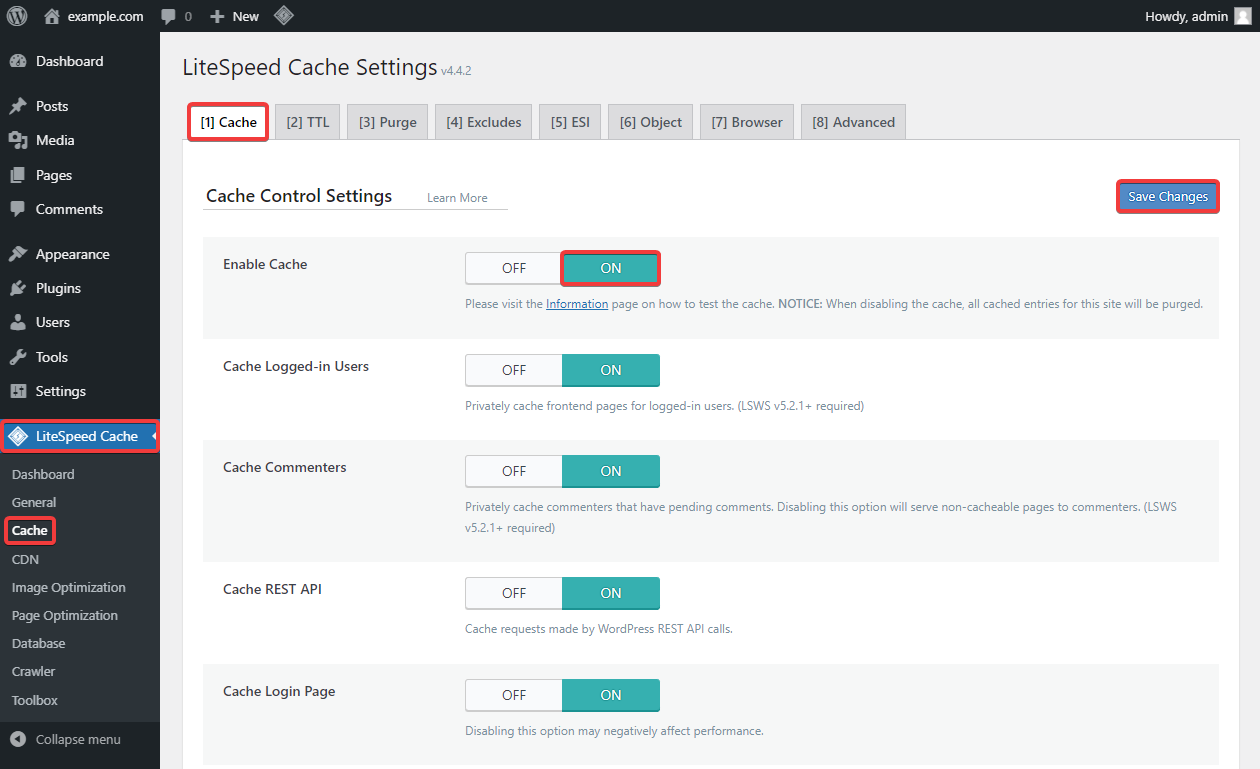
The most important setting in any WordPress LiteSpeed configuration is enabling page caching. Once active, LiteSpeed automatically caches public pages.
Do not cache logged-in users. This can cause issues with admin sessions, account pages, and personalised content.
For most modern themes, mobile caching should remain disabled. Responsive designs already adapt using CSS, so separate mobile cache versions are unnecessary and often introduce complexity.
Enable browser caching. This allows returning visitors to store static assets like images, CSS, and JavaScript locally, improving repeat visit performance.
WordPress LiteSpeed Cache Lifetimes (TTL)
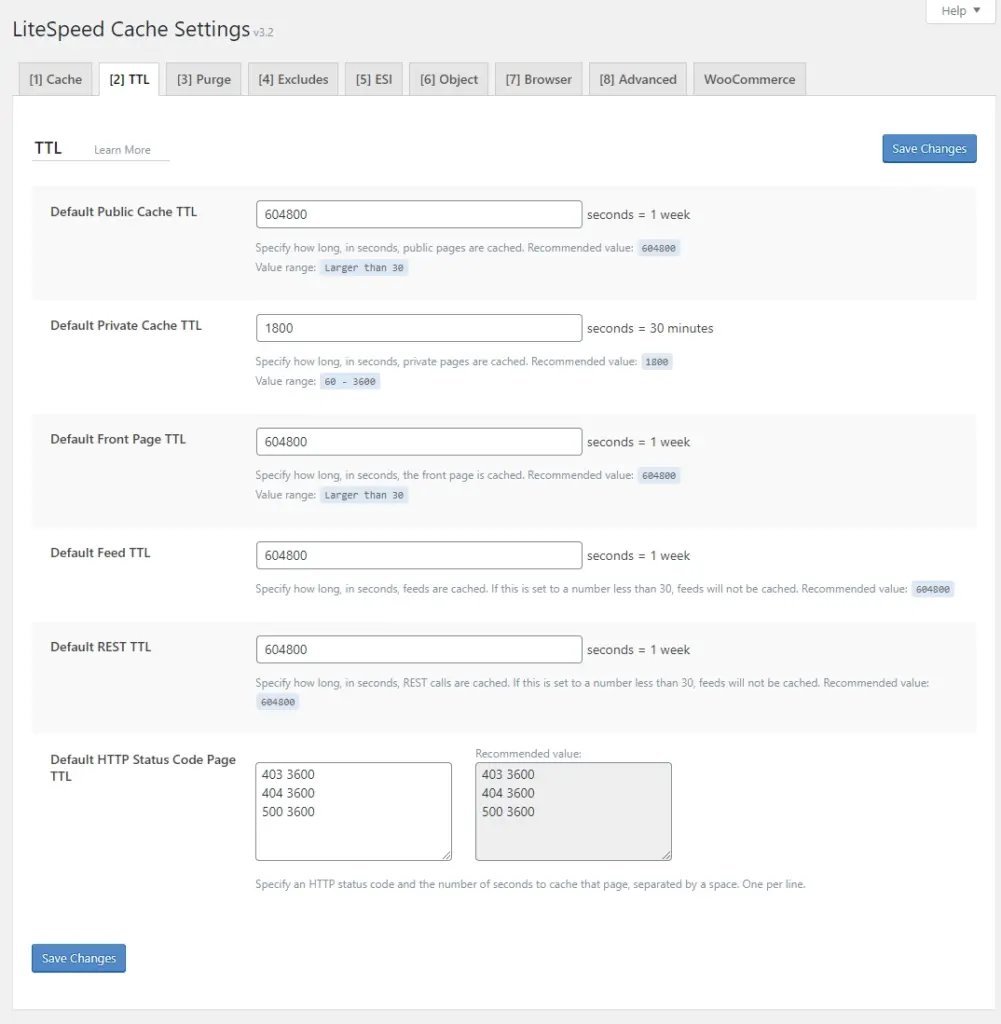
Cache lifetimes determine how long stored pages remain before refresh.
In most WordPress LiteSpeed deployments, a public cache TTL of around seven days works well. If your homepage changes frequently, reduce that TTL slightly. Otherwise, defaults are usually optimal.
Over-adjusting TTL values rarely produces meaningful performance improvements and often complicates management.
WordPress LiteSpeed Purging and Updates
A properly configured WordPress LiteSpeed setup automatically clears relevant cache when content is updated.
Ensure purge on plugin and core WordPress updates is enabled. This prevents visitors from seeing outdated content.
Manual cache clearing should only be required after major redesigns or troubleshooting.
WordPress LiteSpeed Image Optimisation
WordPress LiteSpeed includes built-in image optimisation that should be enabled on nearly every site.
Images are compressed without visible quality loss, reducing page weight significantly. Automatic background optimisation ensures images are processed gradually without affecting live performance.
This is one of the easiest wins in any WordPress LiteSpeed configuration.
WordPress LiteSpeed Page Optimisation Settings
Minifying CSS and JavaScript is generally safe and provides small but measurable gains.
However, combining CSS and JavaScript files is usually unnecessary on servers running HTTP/2 or HTTP/3. In some WordPress LiteSpeed environments, file combination may even reduce performance.
Advanced features like asynchronous CSS loading can improve lab test scores but should always be tested carefully, as some themes may render incorrectly.
WordPress LiteSpeed Media Loading and Core Web Vitals
Lazy loading images and iframes is highly recommended.
In a properly configured WordPress LiteSpeed setup, lazy loading helps improve Core Web Vitals by deferring below-the-fold content until needed. This improves perceived speed and initial load times without breaking layout.
WordPress LiteSpeed Database Optimisation
Database optimisation tools are helpful but should be used conservatively.
Running monthly cleanups for revisions and expired transients is sufficient. Aggressive scheduling provides minimal benefit and increases risk unnecessarily.
Common WordPress LiteSpeed Configuration Mistakes
Most performance problems occur when:
Multiple caching plugins are installed
Too many optimisation features are enabled at once
Logged-in users are cached
Settings are aggressively over-tuned
WordPress LiteSpeed performs best when configured simply and allowed to handle caching at the server level.
Object Caching with Redis or Memcached
Page caching speeds up what a visitor sees, but object caching speeds up what WordPress itself has to do behind the scenes: database queries for things like menus, options and post metadata get stored in memory instead of hitting MySQL every time. LiteSpeed Cache supports Redis and Memcached as object cache backends, and turning this on makes the biggest difference on dynamic, logged-in-heavy sites such as WooCommerce stores or membership sites, where page caching alone can't help because so much of the page is personalised per visitor. If your host offers Redis, enabling it under LiteSpeed Cache's Object tab is usually a safe, worthwhile change; if it's not available, this step simply isn't relevant to your setup.
QUIC.cloud CDN and Image Optimisation
LiteSpeed Cache integrates with QUIC.cloud, LiteSpeed's own CDN and optimisation service, which handles global content delivery, off-server image compression, and low-quality image placeholders (LQIP) for a perceived speed boost while full images load. It runs on a free tier with daily usage limits, then moves to paid tiers for high-traffic sites. It's optional. A well-configured origin server with LiteSpeed caching already covers most of the performance win; QUIC.cloud is worth adding once a site has meaningful traffic from outside the UK, or when you want image optimisation offloaded from your own server entirely.
ESI: Caching a Page That Has a Shopping Cart on It
Normally a page with a personalised element, such as a WooCommerce mini-cart showing item count, can't be fully cached because that one element differs per visitor. Edge Side Includes (ESI) solves this by letting LiteSpeed cache the rest of the page as normal while treating the personalised block as a separate, uncached fragment stitched back in on delivery. This is why a properly configured WooCommerce store can still get full-page caching almost everywhere, with only the cart icon updating per visitor. LSCache's WooCommerce integration handles this automatically once enabled; it rarely needs manual configuration, but it's worth knowing why an e-commerce site can be fully cached at all.
If a Plugin Breaks After Enabling LiteSpeed Cache
Occasionally a plugin that writes personalised content into a page (a quiz, a dynamic pricing calculator, a custom login widget) will appear broken or show stale data once page caching is turned on, because it wasn't designed with server-level caching in mind. The fix is almost never to disable caching site-wide. Instead, use LiteSpeed Cache's page-level exclude rules to stop caching that one specific URL or query string, or add the plugin to the "Do Not Cache" list under the Excludes tab. If a page looks fine one moment and stale the next after a content update, check that "Purge on Upgrade" and "Auto Purge Rules" are both enabled, since a missed purge trigger is the most common cause of visitors seeing old content.
Frequently Asked Questions
Do I need object caching (Redis) as well as page caching?
Not always. Page caching alone covers most brochure and blog sites well. Object caching via Redis or Memcached matters most for WooCommerce stores, membership sites, or anything with a lot of logged-in, personalised traffic.
Is QUIC.cloud CDN necessary for good performance?
No, it's optional. A correctly configured LiteSpeed Cache setup on the origin server already delivers most of the speed benefit. QUIC.cloud is worth adding for sites with significant traffic from outside the UK or that want image optimisation offloaded entirely.
Why does my page show old content after I update it?
This is almost always a missed cache purge. Check that "Purge on Upgrade" and "Auto Purge Rules" are enabled in LiteSpeed Cache, and manually purge the cache after major changes if needed.
Can I run WooCommerce with LiteSpeed page caching enabled?
Yes. LSCache uses Edge Side Includes (ESI) to cache the rest of the page while treating personalised elements like the cart icon as a separate fragment, so most of a WooCommerce store can still be fully cached.